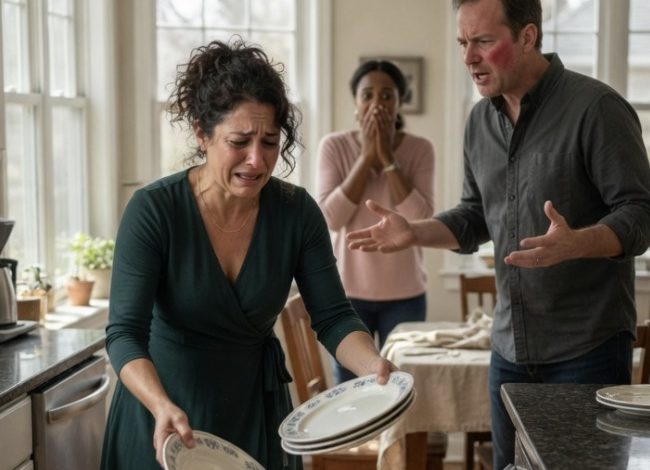
Quand mon nouveau mari m’a frappée parce que j’avais refusé de servir sa sœur, j’ai mis fin au mariage avant même le début de la lune de miel.
Je pensais que le mariage nous rapprocherait. Au lieu de cela, une simple dispute lors d’un dîner a révélé une vérité choquante sur ma nouvelle famille.
Deux jours après mon mariage, j’ai appris qu’un mariage pouvait se transformer avant même que les fleurs des tables de réception n’aient commencé à faner.
Je m’appelle Emily Harper et j’ai épousé Daniel Whitmore un samedi après-midi ensoleillé à Portland, dans l’Oregon. Il avait trente-deux ans, était élégant, charmant, le genre d’homme qui se souvenait du nom des serveurs et ouvrait les portières de voiture sous le regard des autres. Sa sœur cadette, Vanessa, avait vingt-sept ans et vivait chez lui « temporairement » depuis près d’un an.
Avant le mariage, Daniel m’a dit que Vanessa était fragile. « Elle a beaucoup souffert », m’a-t-il dit. « Sois patient avec elle. »
J’ai essayé.
Je l’ai vraiment fait.
Lundi soir, je suis rentrée du travail avec les pieds douloureux, portant encore le chemisier de ma journée d’intégration à mon nouveau poste. Daniel m’avait envoyé une liste de courses par SMS pendant ma pause déjeuner, puis avait appelé deux fois pour me rappeler que Vanessa aimait sa purée « très beurrée ». En ouvrant la porte d’entrée, la télévision diffusait une émission de téléréalité à plein volume. Vanessa était blottie sur le canapé sous une couverture, les yeux rivés sur son téléphone, riant aux éclats devant l’écran.
L’évier de la cuisine était plein. Des canettes de soda vides jonchaient la table basse. Daniel se tenait près du comptoir, les bras croisés, comme s’il attendait un domestique.
« Vous êtes en retard », dit-il.
« Il est 6h20 », ai-je répondu prudemment. « La circulation était dense. »
Vanessa ne quittait pas la télévision des yeux. « Je meurs de faim. »
J’ai quand même cuisiné. Du poulet, des pommes de terre, des haricots verts. J’ai dressé les assiettes et mis deux plats sur la table. Daniel s’est assis. Vanessa est restée sur le canapé, les yeux rivés sur l’écran.
« Le dîner est prêt », ai-je dit.
« Apportez-le ici », dit Vanessa en agitant la main sans se retourner.
Je la fixai du regard. « Tu peux manger à table. »
Le silence se fit dans la pièce, hormis les rires provenant de la télévision.
La chaise de Daniel grinça en arrière. « Qu’est-ce que tu viens de dire ? »
« Je lui ai dit qu’elle pouvait manger à table », ai-je répondu. « Je ne vais pas servir le dîner à quelqu’un scotché à la télé comme si j’étais un employé de maison. »
Vanessa finit par jeter un coup d’œil, le visage crispé. « Waouh. Deux jours et elle se prend déjà pour la reine des lieux. »
Daniel a traversé la pièce si rapidement que j’ai reculé par instinct.
« Excusez-vous », a-t-il lancé sèchement.
“Non.”
Sa main m’a frappée au visage avant même que je comprenne son mouvement. Une douleur fulgurante m’a traversé la joue. J’ai eu un bourdonnement dans l’oreille. Pendant une seconde, tout s’est figé : les éclairs bleus et blancs de la télévision, la bouche de Vanessa légèrement ouverte, Daniel qui respirait bruyamment devant moi.
Puis quelque chose en moi s’est brisé net en deux.
Without hesitation, I shoved the food away with force. Plates crashed onto the floor. Chicken slid across the tile. The bowl of green beans shattered near Daniel’s shoes.
I looked him directly in the eyes and said, “You just made the biggest mistake of your life.”
PART 2
Daniel stared at the broken dishes as though they offended him more than the slap had offended me.
For years afterward, I would remember that moment in fragments: the sting burning across my cheek, the smell of butter and garlic, Vanessa clutching the blanket against her chest, Daniel’s face shifting from rage to shock when he realized I was not crying.
He expected tears. He expected begging. He expected me to lower my eyes and apologize for embarrassing him in his own house.
Instead, I reached for my phone.
Daniel lunged toward me. “What are you doing?”
I stepped back and lifted the phone high. “Calling the police.”
Vanessa jumped up. “Are you insane? It was one slap.”
“One slap two days after the wedding,” I said, my voice shaking but clear. “That’s not a mistake. That’s a preview.”
Daniel’s expression changed again. The anger faded just enough for calculation to show. He softened his voice, using the same tone he had used with my parents at the rehearsal dinner.
“Emily,” he said, “don’t be dramatic. I lost my temper. You threw food everywhere.”
“You hit me first.”
“You humiliated my sister.”
“I asked her to sit at a table.”
Vanessa scoffed. “You came into our family acting like a queen.”
That sentence told me everything.
Our family. Not my home. Not our marriage. Their family, where I was supposed to earn my place by serving them.
Daniel took another step toward me. “Put the phone down.”
I dialed 911.
His eyes widened.
When the operator answered, I gave the address before Daniel could speak. I said my husband had slapped me across the face, that I did not feel safe, and that I wanted officers sent to the house. Daniel started talking over me, insisting I was emotional, newly married, stressed from wedding planning. Vanessa shouted that I had destroyed the kitchen.
The operator told me to move away from them if I could.
I grabbed my purse from the chair.
Daniel blocked the hallway.
“Move,” I said.
“You are not leaving this house like this.”
I looked at him, truly looked at him. This was the man who had danced with me two nights earlier beneath string lights, whispering that he would protect me forever. Now he stood between me and the front door, his jaw tight, his hand still red from hitting me.
“I am leaving,” I said. “And you will not touch me again.”
For one second, I thought he might.
Then headlights swept across the living room window.
Vanessa whispered, “You actually called them.”
“Yes,” I said. “I actually did.”
The police knocked hard. Daniel stepped aside with a curse under his breath. I opened the door before he could put on another version of himself.
Two officers entered. One spoke with me in the hallway while the other stayed with Daniel and Vanessa. I told the truth. I did not decorate it. I did not exaggerate. I said he yelled, slapped me, and tried to stop me from leaving. My cheek was already swelling.
Daniel told them I had “gone crazy” and thrown dinner.
The older officer looked at the broken plates, then at my face.
“Do you have somewhere safe to go tonight?” she asked.
I nodded. “My friend Rachel lives twenty minutes away.”
I packed a bag while the officer stood at the bedroom door. Daniel watched from the living room, silent now, his mask cracked but not completely gone.
As I zipped my suitcase, my wedding dress hung from the closet door inside its garment bag, white and useless.
I left my ring on the kitchen counter beside the pieces of shattered plate.
PART 3
Rachel Morgan opened her apartment door before I had even knocked twice.
She was thirty-one, a nurse, and the kind of woman who could read damage in a single glance. Her eyes went straight to my cheek. She did not gasp. She did not ask what I had done to cause it. She simply stepped aside and said, “Come in.”
That was the first kindness that made me cry.
I sat at her small kitchen table while she wrapped an ice pack in a towel. The apartment smelled like coffee and lavender detergent. Outside, Portland rain tapped softly against the windows, ordinary and calm, as though my life had not split open in the last hour.
Rachel placed the ice pack against my cheek.
“Did the police take a report?” she asked.
“Yes.”
“Good.”
Her voice was steady, but her hands trembled when she turned away to fill the kettle.
I stared down at my left hand. The pale mark where my ring had been looked strange, almost indecent. Two days married. Forty-eight hours. People still had not finished liking our wedding photos online, and I was sitting in my best friend’s apartment with a swollen face and a police report number in my purse.
My phone started buzzing at 9:14 p.m.
Daniel.
Then Daniel again.
Then Vanessa.
Then Daniel’s mother, Patricia.
Rachel looked at the screen. “Do not answer.”
“I know.”
But knowing and resisting were not the same thing.
The messages came in waves.
Daniel: You embarrassed me in front of my sister.
Daniel: I said I was sorry.
He had not said he was sorry.
Daniel: We need to talk like adults.
Vanessa: You are seriously ruining his life over one slap?
Patricia: Emily, marriage requires forgiveness. Call me.
Then Daniel sent a photo from our wedding. The two of us smiling beneath the arch, his hand around my waist, my face turned toward him like I had found safety.
Below it, he wrote: Don’t destroy this because you’re angry.
I turned the phone face down.
Rachel sat across from me. “Tomorrow, we go to the courthouse.”
I looked up. “For what?”
“A protective order, if you want one. And then a lawyer.”
The word lawyer sounded enormous. Bigger than divorce. Bigger than police. It sounded like a door closing.
“I don’t even know if an annulment is possible,” I said.
“Then we find out.”
I slept badly on Rachel’s couch. Every time a car passed outside, my body tightened. I replayed the moment over and over: Daniel’s hand, the sound, Vanessa’s face, the food hitting the floor. By morning, my cheek had darkened into a bruise no makeup could fully cover.
At 8:30 a.m., Rachel drove me to the courthouse.
I expected the building to feel dramatic, but it did not. It was gray, crowded, fluorescent, full of people holding folders and trying not to cry. A clerk gave me paperwork. I wrote Daniel’s name, my name, the address, the incident. My hand cramped from gripping the pen too tightly.
When I reached the section asking whether there had been threats or attempts to prevent me from leaving, I stopped.
Rachel touched my shoulder. “Write it.”
So I did.
By that afternoon, I had a temporary protective order. It was not a magic shield. It was paper. But it was paper that said the law had heard me.
The lawyer’s office was downtown, on the sixth floor of a building with narrow windows and quiet carpet. Her name was Marjorie Klein. She was in her fifties, sharp-eyed, calm, and direct.
She listened without interrupting. Then she asked for dates.
“Wedding was Saturday, June 14,” I said. “He hit me Monday, June 16.”
Her eyebrows lifted slightly, but her face stayed professional.
“Do you have witnesses?”
“His sister saw it.”
“Will she admit it?”
“No.”
“Any photos?”
Rachel had taken pictures of my cheek that morning in natural light. I handed them over. Marjorie studied them, then nodded once.
“Police report?”
I gave her the report number.
“Good,” she said. “Here is what we are going to do. We will file for divorce immediately. Annulment may be difficult depending on the grounds, but divorce is straightforward. You need distance, documentation, and no private contact.”
“No private contact,” I repeated.
“None. He will try different approaches. Anger, apology, guilt, romance, panic. Do not respond. Everything goes through counsel.”
She was right.
Daniel tried anger first.
He sent messages from new numbers after I blocked his. He said I had made him look like a criminal. He said his boss’s wife knew someone at the police department and rumors might spread. He said I was selfish, unstable, ungrateful.
Then he tried apology.
He emailed me a long message titled “My Heart.” He wrote that stress had overwhelmed him, that Vanessa had been difficult since childhood, that he felt trapped between his wife and his sister. He said he loved me more than anyone and that he hated himself for hurting me.
He did not say, “I chose to hit you.”
He said, “Things got out of control.”
Then he tried romance.
Flowers arrived at Rachel’s apartment even though I had never given him the address. That scared me more than the angry messages. The card said: Come home, Mrs. Whitmore.
Rachel threw the flowers into the dumpster behind her building.
I filed a police update.
Then came guilt.
Patricia called my mother, crying. My mother, Linda, had always liked Daniel. She liked polished men with firm handshakes and stable jobs. At first, she asked me whether I was sure I wanted to “end a marriage over one incident.”
I sent her the photo of my cheek.
She called back five minutes later, and her voice sounded different.
“I’m sorry,” she said.
Those two words loosened something inside me.
My father, George, drove from Salem the next day. He was sixty-one, a retired mechanic, quiet and broad-shouldered. When he saw me, he hugged me so carefully I almost broke down again.
“I should have seen something,” he said.
“So should I,” I whispered.
He pulled back. “No. He hid it. That’s on him.”
The next month moved with strange speed. I returned to Daniel’s house once, escorted by police, to collect the rest of my belongings. Calling it Daniel’s house felt correct now. I had lived there for only two nights as his wife. My clothes were still in moving boxes. My favorite coffee mug sat in the cabinet, clean and untouched. The bed was made.
Vanessa was there.
She leaned against the hallway wall with her arms crossed while I packed.
“You’re enjoying this, aren’t you?” she said.
I ignored her.
She followed me into the bedroom. “Daniel is barely sleeping.”
I folded sweaters into a suitcase.
“He cries,” she said. “He actually cries because of you.”
I looked at her then. She wore sweatpants and one of Daniel’s old college hoodies. Her hair was pulled into a messy bun, and her eyes were sharp with resentment.
“Vanessa,” I said, “your brother hit me.”
Her mouth tightened. “You provoked him.”
“No. I disobeyed the system you two built.”
For the first time, she did not have an immediate answer.
I closed the suitcase.
“You wanted me to become what you were used to,” I continued. “Someone who cooked, cleaned, served, stayed quiet, and took the blame when Daniel lost control. I was in that house for two days, and he already showed me the rules. I’m lucky he showed me early.”
Her face flushed. “You think you’re better than us.”
“No,” I said. “I think I’m leaving.”
The officer in the hallway stepped forward slightly, and Vanessa moved back.
I walked out with my suitcases and did not look at the wedding photo still sitting on the mantel.
Daniel contested the divorce at first. He claimed we could reconcile. He claimed I had abandoned the marital home. He claimed I was exaggerating for attention. But documentation has a weight charm cannot easily lift. The police report existed. The photographs existed. The protective order existed. The messages existed, especially the ones where he admitted he “lost control.”
Marjorie told me to stay patient.
“He wants a private emotional battlefield,” she said. “We are keeping this in writing, in court, and on record.”
Daniel hated that.
At the first hearing, I saw him across the room in a navy suit, looking thinner but still handsome. His hair was neatly combed. His mother sat behind him. Vanessa was not there.
He looked at me once, long and wounded, as if I had betrayed him by surviving his version of marriage.
My hands trembled beneath the table.
Marjorie leaned toward me. “Breathe.”
The judge reviewed the temporary order and the evidence. Daniel’s attorney tried to frame the incident as a newlywed argument that had escalated on both sides. Marjorie did not raise her voice. She simply laid out the sequence.
Dinner disagreement.
Screaming.
Physical strike.
Attempt to block departure.
Police call.
Visible injury.
Repeated unwanted contact.
Flowers sent to an undisclosed address.
The judge extended the protective order.
Daniel’s face hardened.
That was the moment I stopped seeing two Daniels—the charming one and the violent one. There was only one man. The charm had not exactly been fake. It had been a tool. The rage was another tool. He used whichever one worked.
After the hearing, Patricia approached me in the hallway.
Rachel stepped between us, but Patricia raised both hands.
“I just want to say something,” she said.
Marjorie’s voice cut in. “Mrs. Whitmore, be careful.”
Patricia’s lips trembled. She looked older than she had at the wedding, her makeup settled into tired lines.
“I told him to apologize,” she said to me. “I told him he couldn’t do that.”
I said nothing.
Then she added, almost bitterly, “But you didn’t have to call the police.”
There it was.
Not remorse. Not accountability. Reputation management.
I walked away.
The divorce was finalized seven months later.
By then, I had moved into a small one-bedroom apartment near my office. The place had old floors, thin walls, and a view of a brick building, but it was mine. I bought a round dining table just big enough for two chairs. The first night it was delivered, Rachel came over with Thai food and a bottle of sparkling cider.
We ate at the table.
No television. No orders. No one waiting to be served.
Just two women laughing too loudly in a half-furnished apartment while rain slid down the windows.
A week after the divorce, Daniel sent one final email through his attorney. It was brief.
I hope someday you understand what you destroyed.
I read it once, then forwarded it to Marjorie. I did not answer.
Because I did understand.
I had destroyed the future where I learned to flinch at footsteps. I had destroyed the marriage where dinner plates mattered more than my face. I had destroyed the illusion that a wedding ring could turn control into love.
And I had done it two days after the wedding, before a mortgage, before children, before years of excuses could wrap around me like chains.
Months later, I ran into Vanessa at a grocery store.
She was standing in the frozen food aisle, thinner than before, her face bare of makeup. For a moment, we both froze. She looked toward the exit as if considering escape, then back at me.
“Emily,” she said.
“Vanessa.”
There was no screaming. No audience. Only the hum of freezer lights.
She swallowed. “Daniel moved to Seattle.”
“I heard.”
“He and Mom don’t talk much now.”
I said nothing.
Vanessa serra la poignée de son panier. « Il s’est mis à me crier dessus après ton départ. Encore plus qu’avant. »
Les mots restaient là, lourds et tardifs.
« Je suis désolé », ai-je dit.
Elle laissa échapper un petit rire sans joie. « Tu avais raison au sujet du système. »
Je l’ai alors regardée, vraiment regardée. Elle n’était pas innocente dans ce qui m’était arrivé. Elle s’était moquée de moi, l’avait excusé, l’avait protégé. Mais elle avait aussi vécu dans cette maison plus longtemps que moi. Peut-être avait-elle appris à survivre en se rendant utile à celui qui l’effrayait.
Cela n’efface pas ce qu’elle a fait.
Cela n’a fait que rendre la situation plus claire.
« Prends soin de toi », ai-je dit.
Elle hocha la tête, les yeux brillants, et s’éloigna.
Je ne l’ai jamais revue.
Pour ce qui aurait été mon premier anniversaire de mariage, je ne suis pas restée chez moi à broyer du noir. J’ai emmené mes parents et Rachel dans un restaurant avec vue sur la rivière Willamette. Mon père portait le même costume qu’à mon mariage, mais cette fois, son sourire était naturel. Ma mère a commandé le dessert en premier car, comme elle l’a dit, « on fête ça à l’envers ».
Rachel leva son verre.
« À Emily », dit-elle. « Pour être partie avant que la situation ne s’aggrave. »
J’ai jeté un coup d’œil autour de la table. Aux mains burinées de mon père. Au sourire prudent de ma mère. Au regard perçant de Rachel. Aux lumières de la ville qui tremblaient sur l’eau, au loin.
Puis j’ai touché ma joue.
Il n’y avait plus de bleu. Plus aucune marque visible. Mais je me souvenais de la gifle, non pas comme du moment où je me suis brisée, mais comme du moment où la vérité est devenue impossible à ignorer.
Daniel voulait qu’on lui obéisse.
Vanessa avait besoin d’être servie.
Patricia souhaitait le silence.
J’ai choisi la porte.
Et lorsque des gens m’ont demandé plus tard pourquoi mon mariage s’était terminé après seulement deux jours, j’ai cessé de me dérober à la réponse.
J’ai dit : « Parce que le deuxième jour, il m’a frappée. Et le deuxième jour, je suis partie. »
Voilà toute l’histoire.
Ni scandale, ni échec, ni tragédie déguisée en drame.
Un début.